We published our first full review of Deevid AI in early Q1. Six weeks later, after another fifty or so client deliverables run through the platform, here’s what we’d add — and a few caveats we hadn’t fully appreciated when we first scored it.
What’s holding up
The multi-model proposition is the thing. This is what we underweighted in the initial review. The fact that you can swap between Sora 2, Veo 3.1, Kling, Runway, Pika and the others inside one tool turns out to be more valuable than any single model’s marginal output quality. We’ve moved from “Deevid is a video tool” to “Deevid is the way I avoid having three video subscriptions.”
In practical terms: on a six-shot narrative we shipped last week, we used three different underlying models — Kling for the character close-ups, Sora 2 for the wide cinematic establishing shots, Pika for one fast iteration we needed before lunch. Each of those is normally a separate $20-30/month subscription. Bundled, $25/month total.
Character consistency on Lite at $10/month is still the deal that surprises everyone we tell about it. Most competitors lock this behind a Pro-tier plan north of $30/month. It’s structurally a better starting point for freelancers who only occasionally need character continuity.
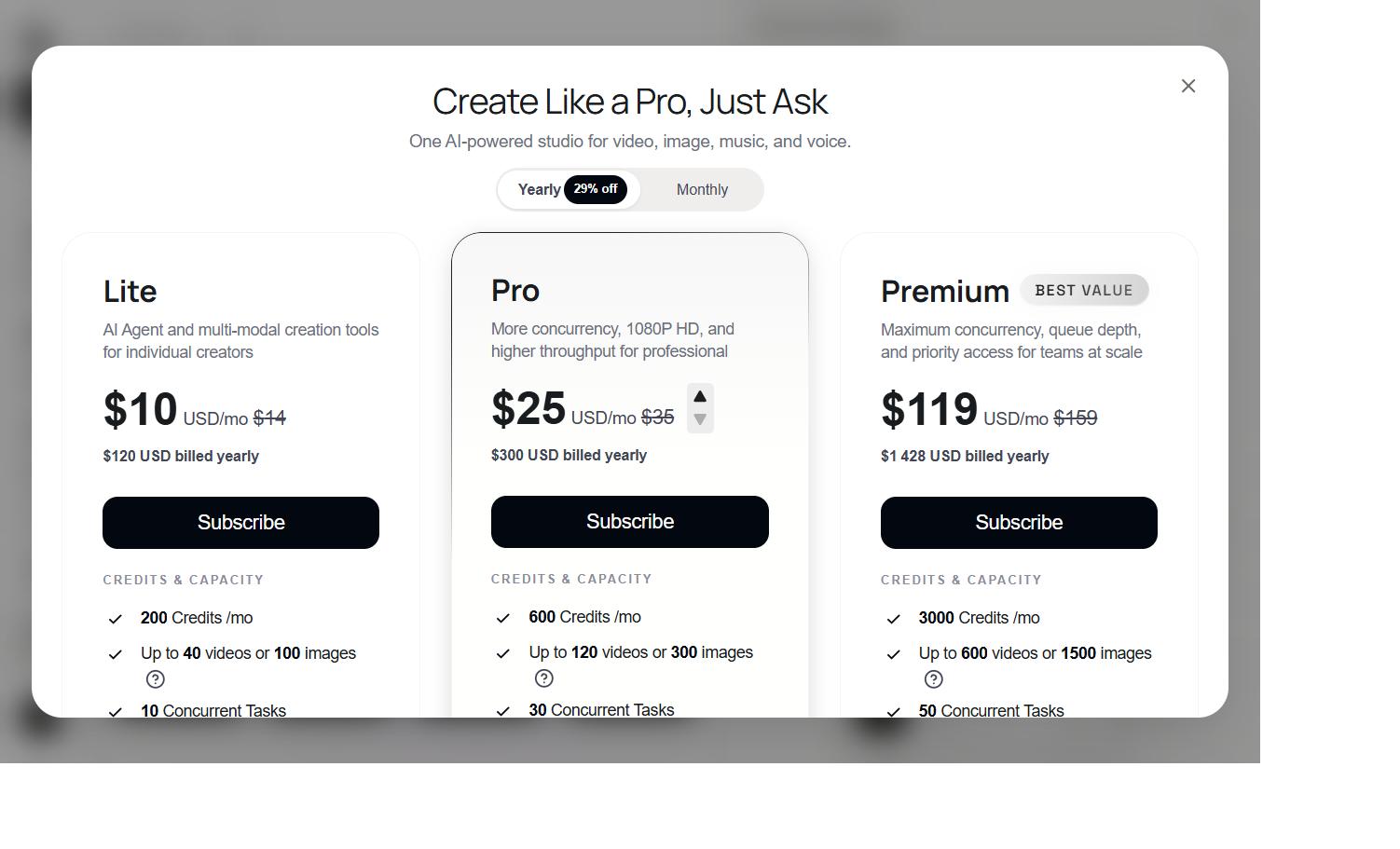
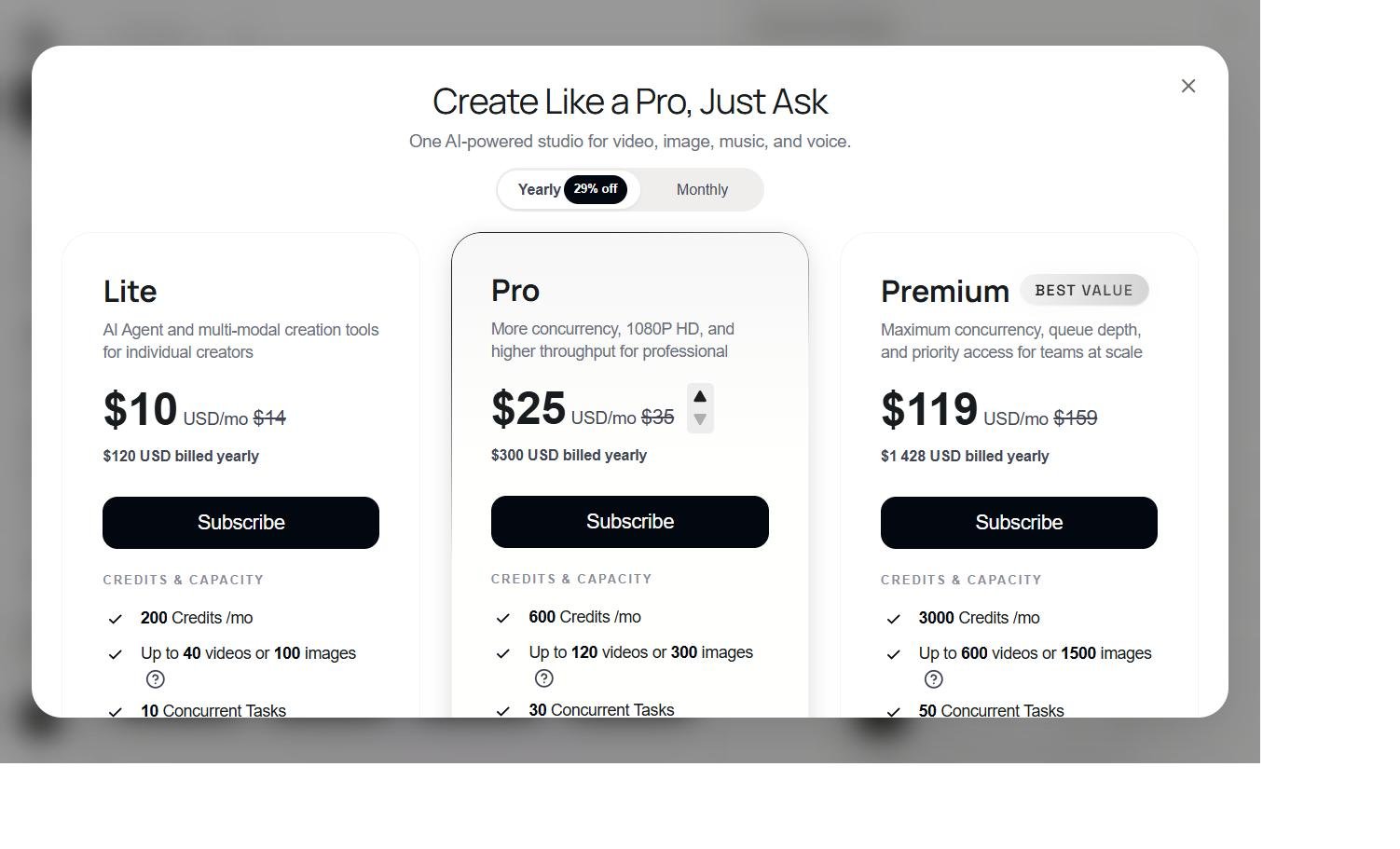 Deevid’s three paid tiers as of Q2 2026 — Lite $10, Pro $25, Premium $119. Character consistency is included on every tier, even Lite.
Caveats we’d add
The 1080p ceiling is a real constraint for some use cases. We initially thought “1080p is fine” — and for social, it is. But for the in-store digital signage brief we picked up last month, we ended up running outputs through external upscalers anyway. If you’re producing for anything bigger than a desktop monitor, factor in a Topaz or similar at the end of your pipeline.
Model selection has a learning curve we glossed over. Picking the right model per shot is a real skill — and the wrong choice eats credits for output you can’t use. We’d now recommend new users spend the first 50 credits running the same prompt through three different models to learn which one fits their style. That investment pays back fast.
The credit system makes monthly budgeting harder than flat plans. A complex prompt or longer clip can cost more credits than the simple math of “200 credits ÷ 5 = 40 videos” suggests. Plan for ~30-35 actual videos on Lite, ~100 on Pro, ~500 on Premium — and keep some headroom.
Prefer to watch? Here’s Deevid AI’s official product walkthrough:
What’s coming (per Deevid’s roadmap)
We don’t speak for Deevid, but their public communications point toward more model integrations through Q3 (Veo 3.1 is on the way, and there are hints of more specialized vertical models for specific use cases). If that pace continues, the value proposition only strengthens — every new model is one fewer subscription to pay for elsewhere.
We’d also love to see native higher resolutions, but there’s been no public commitment to that.
Score adjustment
Our original score was 9.2/10 and it’s holding. The two things we’d shift:
| Dimension | Q1 score | Q2 score | Why |
|---|---|---|---|
| Output quality | 9.4 | 9.0 | Reset for the 1080p ceiling honesty |
| Value for money | 9.1 | 9.4 | Multi-model bundling is the real story |
Net overall stays at 9.2. The internal weights shifted toward “value” because the more we use Deevid, the clearer it gets that the unit economics are excellent — even if any individual output isn’t always our favorite.
What this means if you’re evaluating
Three takeaways after six more weeks:
- Don’t compare Deevid to Runway or Pika. Compare it to paying for both Runway and Pika and Sora separately. That’s the real choice, and Deevid wins it cleanly.
- Pick the right tier based on volume, not features. Lite gets you everything important. Pro is for people who’d otherwise burn through Lite by mid-month. Premium is volume-only — same features, more credits.
- Test at least three models before settling. The “best model” depends on your style. Sora is not always best. Kling sometimes is. Try them.
We’ll re-test end of July. If anything material changes — new models, pricing changes, resolution updates — we’ll update the main review and note the change on our methodology changelog.
Questions? Email hello@deevidreview.com. We respond to reader mail faster than to press releases.