AI hug video generator: make two photos hug.
An AI hug generator takes two still photos and animates a short clip of the pair pulling into an embrace. We tested the one built into Deevid AI on real photo pairs. Below is how it works, the photos that give a believable hug, what it costs, and an honest word on the emotional side of the trend.
Want to try it on your own photo?Deevid's AI Hug effect is free to test, 20 credits on signup, no card required.
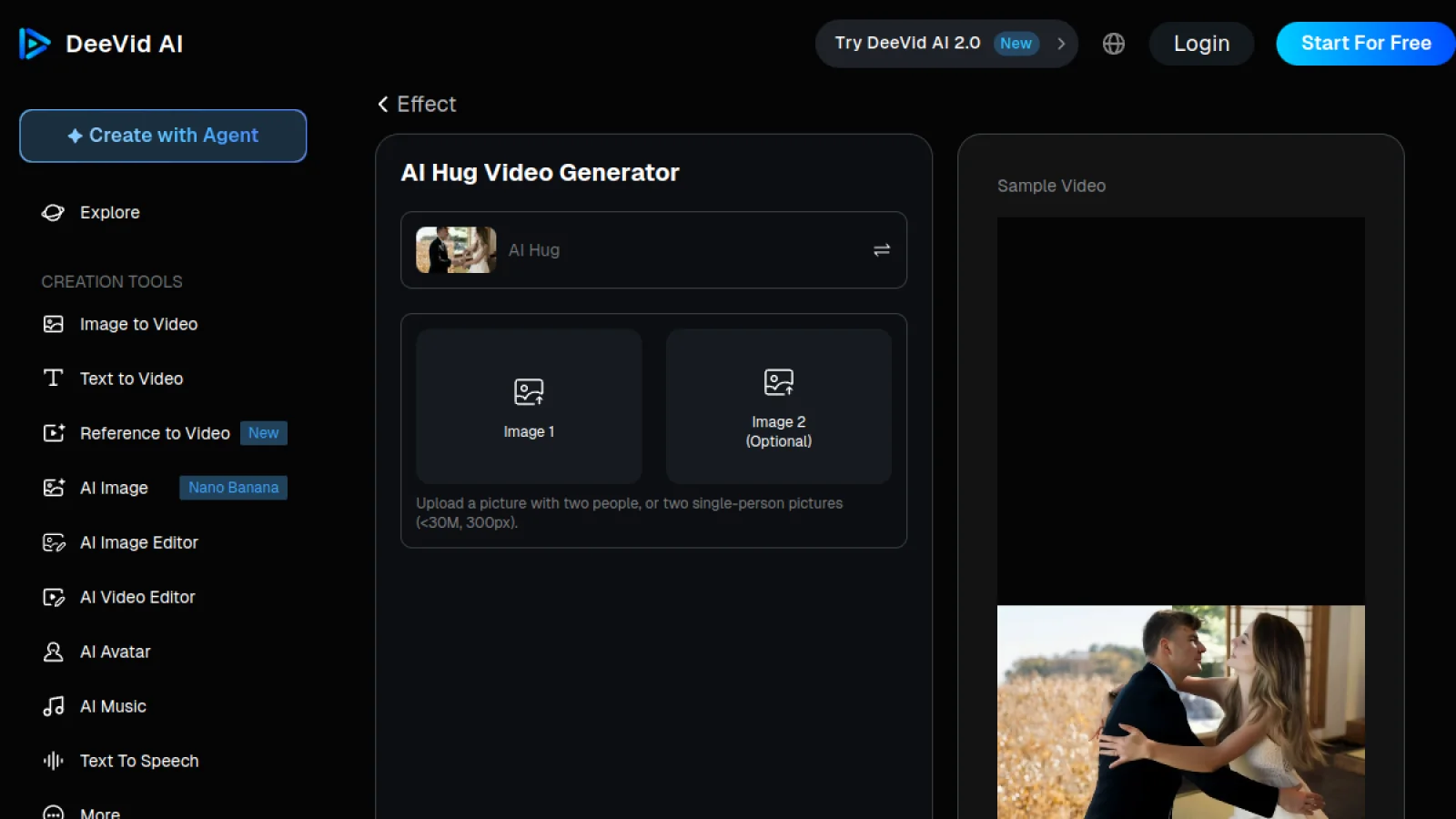
Two photos in, one warm embrace out.
The mechanics are simple: you feed the model a photo of two people (or two separate portraits), and it generates a few seconds of natural motion where they turn and hug. It is the same image-to-video engine behind any modern AI video tool, aimed at one specific, well-defined motion, which is exactly why even free tools land it reliably.
That narrow scope is the whole trick. General text-to-video has to invent a scene, which is where results wobble. A hug effect only has to move two people into a believable embrace, so the model has far less room to go wrong. The differences between generators come down to how natural the arms and faces look, whether the likenesses hold, and how much they charge to remove the watermark.
How to make an AI hug video.
This is the exact flow inside Deevid's AI Hug screen, start to finish. It takes a couple of minutes and no prompt writing.
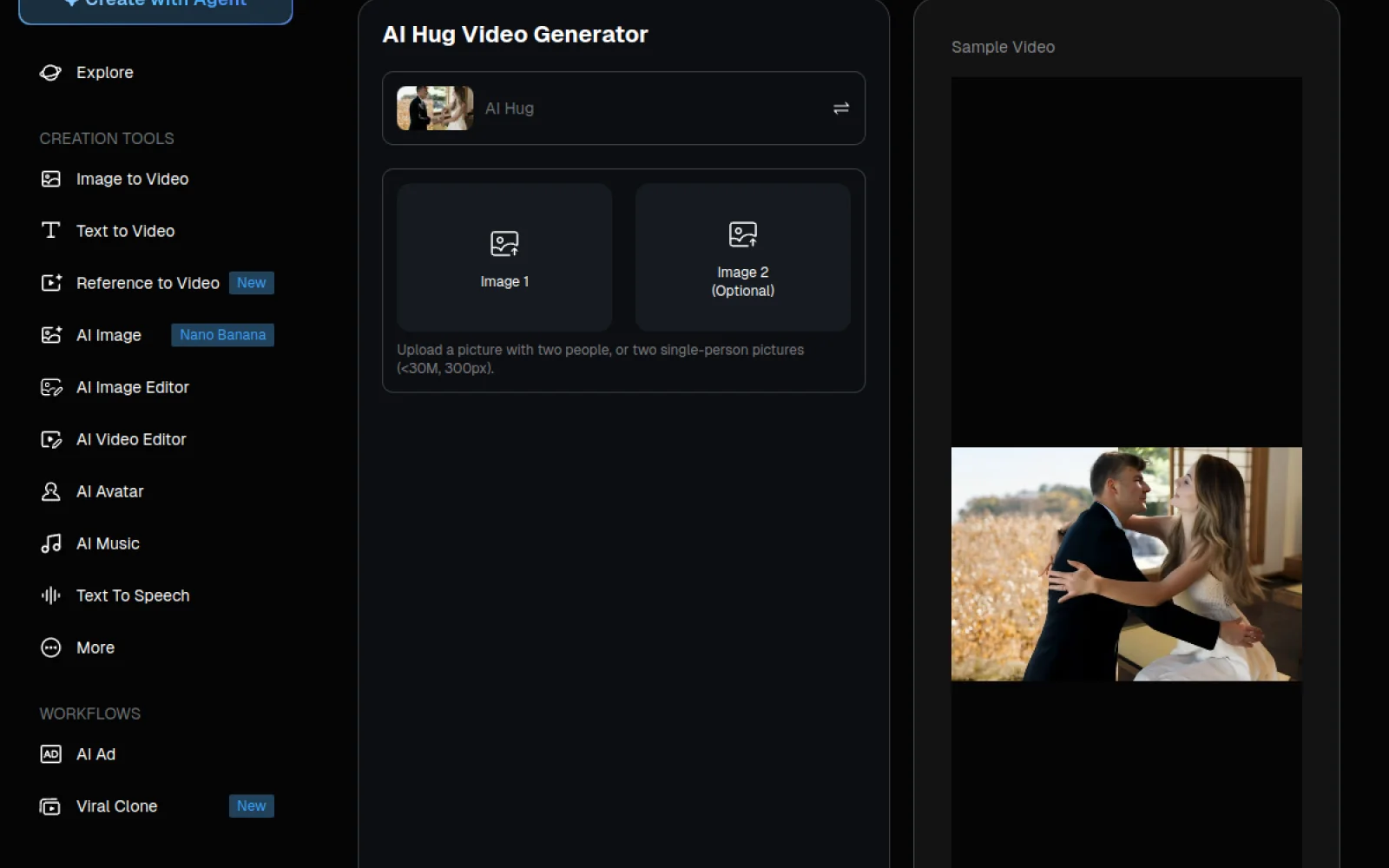
- 1Open the AI Hug effect. Inside Deevid AI, open the Effect gallery and choose AI Hug. It loads a dedicated two-photo screen rather than the standard text-to-video box.
- 2Upload your photo (or two). Drop in one picture that already has both people, or upload two separate single-person photos and let the AI bring them together. Deevid accepts files under 30MB and at least 300px on the short side.
- 3Keep the AI Hug preset. The effect is preset to an embrace, so there is no prompt to write. If the effect list offers variants, pick the one that matches the moment you want, a warm reunion versus a quick side hug.
- 4Set the resolution and hit Create. Choose an output resolution and press Create. A short clip renders in the preview panel on the right, usually within a minute or two depending on load.
- 5Review and download. Play the sample, regenerate if the arms or faces drift, then download. Free renders carry a small Deevid watermark; a paid plan removes it and unlocks a commercial license.
One detail worth repeating from the upload screen: you can pass either a single image containing both people or two single-person photos. That second path is what lets you place two people together who were never photographed side by side.
More than a novelty, for a lot of people.
The kiss effect is mostly playful. The hug effect is often not. The clips that go most viral are the quiet ones: someone reunited with a grandparent who has passed away, a parent hugging the child they lost, two siblings on different continents finally in one frame, or a person embracing a photo of their own younger self. It is nostalgia and grief as much as it is technology.
That is worth naming, because it changes how you should use the tool. A hug clip of a late relative can be a genuine comfort, or it can reopen a wound, depending on the person and the moment. If you are making one for someone else, ask first. Treat these clips as you would a shared memory, not a gag.
Why we point readers to Deevid for this.
The AI hug SERP is full of single-effect sites that do one trick and gate the download behind a paywall the moment your clip is ready. Deevid does the hug just as well, but it sits inside a full video studio, so the same account also gives you image-to-video, avatars, and 14+ models. If the hug is your entry point and you later want more, you are not starting over on another tool.
- The two-photo flow is built in, no prompt-writing required to get a clean embrace.
- Free to test with 20 signup credits, so you can judge the result on your own photo before paying.
- Runs on web plus iOS and Android on one account, handy when the photos are on your phone.
- Paid plans that remove the watermark also add a commercial license, unlike most single-effect sites.
- The same account also runs the AI kissing effect and dozens of others, so one subscription covers the whole trend cycle.
Test it on your own pair of photos.The AI Hug effect is one click inside Deevid's Effect gallery. See our full Deevid AI review and pricing breakdown before you upgrade.
Is it really free, and what is the catch?
Every result in the search box promises a "free" AI hug generator. Here is what free actually means in practice, so you are not surprised at the download step.
A quick reality check on the common modifiers people search for: "no login" tools still ask you to sign up before the download unlocks. "Unlimited free" almost always means unlimited watermarked previews. Third-party APK downloads for these effects are a common malware vector, so stick to the official web tool or the store apps. If you only need one or two clips for a personal message, the free credits cover it; if you are making them regularly, price out the paid tiers and the free-credit math first.
The photos that actually work.
The generator is only as good as the input. After running a batch of pairs, the pattern is clear: the model struggles with awkward angles and hidden bodies, and shines with simple, front-facing portraits where the arms have room to move.
- Face the camera. Both people looking roughly toward the lens beats profiles. The model rotates them inward cleanly from a frontal start.
- Show the upper body. A hug needs arms and shoulders. Head-only crops give the model nothing to work with, so include at least the chest.
- Match the lighting. Two photos shot in similar light blend far better than a bright selfie paired with a dim one.
- Leave space between them. If you are using one photo, subjects who are slightly apart animate into a hug more naturally than ones already touching.
- Regenerate before you judge. Like any AI video, the first render is rarely the best. Run it two or three times and keep the cleanest take, the same rule we use in our Deevid prompt library.
AI hug generator alternatives.
Plenty of tools rank for this effect. Most are single-purpose hug sites; a few are full video platforms like Deevid. If you want to compare before committing, these are the names you will see most, and how they differ.
- Nero, DomoAI and Vidu each offer a dedicated hug effect with a free-looking preview, then gate resolution and watermark removal behind a plan. Fine for a one-off, less useful once you want more than the single trick.
- Kapwing and PerfectCorp bundle the hug into a wider editor, closer to Deevid in scope but with the effect buried among general tools rather than one click away.
- Single-effect ".ai" hug pages fill the rest of the first page. They are the thinnest option: one effect, aggressive upsell, no wider toolkit. Try them, rarely worth a subscription.
For the wider picture of who wins on price and output, see the full Deevid alternatives hub.
A note on consent.
Animating two people into a hug is a lovely thing between people who want it, and a violation when they do not. Only upload images you have the right to use. Be especially careful with photos of people who have died, and of anyone who has not agreed to being animated. Do not use a hug generator to fabricate a relationship, harass, or mislead. If you would not show the clip to the person in the photo, do not make it. On the platform itself, we cover trust, billing and safety in is Deevid AI legit and safe.
AI hug generator, common questions.
How do you make the AI hug trend video?
Is there a free AI hug generator?
Can I make two people hug who were never photographed together?
How do I send someone a virtual hug?
Do the free hug videos have a watermark?
Is an AI hug generator safe and private to use?
Do I need two photos, or can one work?
Is there an AI hug app for phone?
Ready to make one?Sign up free, open the Effect gallery, and pick AI Hug. Your 20 credits cover the first few clips.