Deevid AI vs Fliki: which one should you pick?
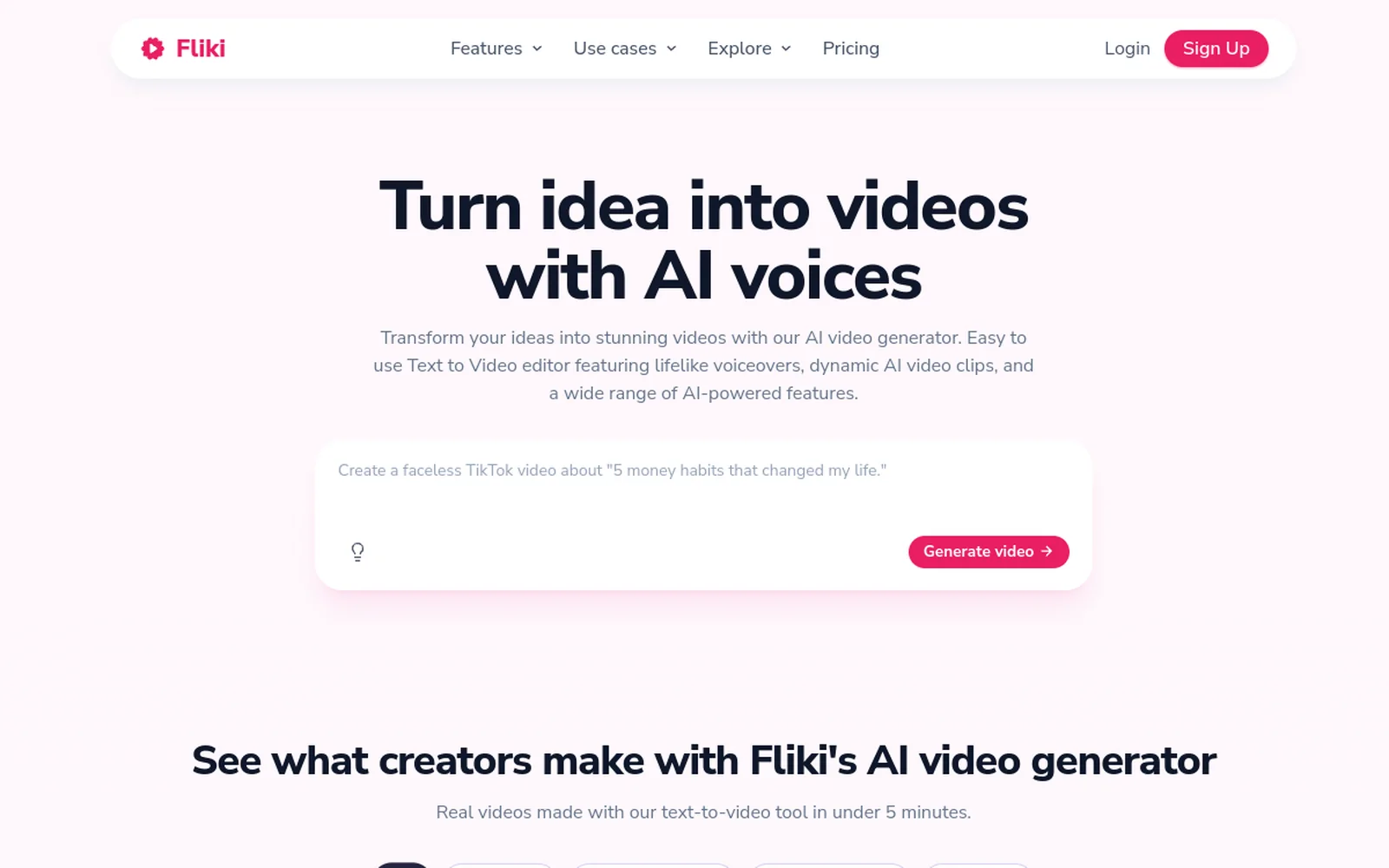
Fliki and Deevid show up in the same Google results but produce fundamentally different videos. Fliki is blog-to-video: script + stock footage + one of 1,300+ AI voices = a faceless YouTube-style explainer. Deevid generates cinematic scenes from prompts using frontier models. If your content is voice-led, Fliki fits. If it's visual, Deevid fits.
Deevid AI vs Fliki, on screen.

Deevid AI vs Fliki, side by side.
We used identical prompts, identical briefs, and identical acceptance criteria for both tools. Here are the raw specs.
| Criteria | Deevid AI | Fliki |
|---|---|---|
| Starting price | $10/mo | $21/mo |
| AI models bundled | ✓ 14+ (Sora 2, Veo 3.1, Kling, Runway, Pika…) | TTS + stock footage assembly — no generative scene models |
| Max resolution | 1080p | 1080p |
| Character consistency | ✓ All paid tiers | ✕ |
| Commercial license | ✓ All paid tiers | Standard+ |
| Watermark on paid | ✕ | ✕ |
| AI music + voice + image | ✓ Pro and Premium | ✕ |
| Our score | 9.2 / 10 | 7.4 / 10 |
Where Deevid AI and Fliki each win.
Each row is a category we tested. The winner column is our call, supported by the side-by-side notes.
The fastest answer is to try both.
Deevid ships 20 free credits on signup — no credit card required. Fliki offers a free tier to test too.
Deevid or Fliki: choosing by workflow.
- Your content is visual-first — ads, product, narrative, stylized social.
- You need generated scenes at frontier model quality, not stock footage with voice-over.
- You want 14+ models to pick from, bundled with music, voice and image generation on Pro.
- A slideshow feel would undercut your work.
- You're producing faceless YouTube, blog-to-video repurposing, or voice-driven educational content.
- Voice library depth matters — 1,300+ voices and dialect range is Fliki's moat.
- You need to batch 60–90 minutes of assembled video per month cheaply.
- Your channel is built on script + voice, not original visuals.
The details most Fliki comparisons miss.
Why Fliki owns the faceless creator market
Fliki has quietly built the strongest tooling in the category for one specific use case: faceless voice-led video at scale. 1,300+ ultra-realistic text-to-speech voices across 80+ languages and 100+ dialects is the category's largest library by a wide margin. For creators running faceless YouTube channels, multilingual podcast repurposing, or blog-to-video automation, no other tool is better optimized. The Standard plan at $21/mo (annual) unlocks 180 credits for 60–90 minutes of assembled video per month — enough to publish daily on a single channel. Fliki's weakness is exactly what makes it specialized: the video side is slideshow-style, not generative, which is a dealbreaker if your content needs original visuals.
The 'slideshow vs generated' quality gap
Fliki's video output is assembled from stock footage, your uploaded assets, and AI voice-over. It's competent for explainer content but reads visually as 'content marketing video' rather than original creative. Deevid AI's output is generated scenes — each frame is something the model produced from your prompt. The difference shows most clearly in two contexts: paid ads (where viewers subconsciously flag templated or stock-heavy content) and premium brand work (where original visuals are table stakes). For those use cases, Fliki's architecture can't produce what you need. For explainer content or voice-led social, Fliki's output is exactly right and the quality gap with Deevid doesn't matter to the viewer.
Voice library: the detail that should drive the decision
If your content is voice-led — narration, explainer, podcast repurposing — the voice library matters more than any other feature. Fliki's 1,300+ voices cover tonal variety, dialects, and languages that Deevid's bundled voice tool (available on Pro+ plans) doesn't match. Deevid treats voice as a supplementary feature inside a broader video pipeline. Fliki treats voice as the primary product. A creator building a brand around a specific voice aesthetic — say, mid-Atlantic documentary narration, or British explainer voice — will find what they need in Fliki and not in Deevid. That's a real moat.
Deevid vs Fliki: the trade-offs.
Deevid AI
- 14+ frontier generative video models
- Original scene generation — not stock assembly
- Better for visual-first content (ads, brand, narrative)
- Full commercial license on every paid tier
- Smaller voice library than Fliki
- No blog-to-video automation
- Not optimized for faceless explainer content
Fliki
- 1,300+ voices across 80+ languages
- Best-in-class for faceless voice-led content
- Cheap volume: 60–90 min assembled video/month at $21
- Blog-to-video automation saves real time
- No generative scene models — all stock/slideshow
- Output looks assembled, not filmed
- Voice library is impressive, but ceiling on visual originality
Common questions: Deevid vs Fliki.
Is Fliki an alternative to Deevid AI?
How much does Fliki cost compared to Deevid?
Does Fliki generate original video?
How good are Fliki's AI voices?
Can I use Fliki for ads?
Which is better for YouTube content?
Deevid AI vs Fliki in action.
Deevid or Fliki — our final call.
If you're publishing voice-led faceless content — blog repurposing, explainer YouTube, multilingual audio — Fliki's TTS library and assembly pipeline make it the cheaper choice. If you're producing anything visual-first, Fliki's slideshow feel won't cut it. Deevid wins on any use case where the frame has to look generated, not stitched.— Marcus Hale, after 30 days with both tools
Try Deevid AI free.
20 free credits on signup, no credit card required. Cancel anytime on paid plans.
Claim 20 free credits →