
Short answer: Tagshop AI is a web platform for making AI UGC video ads. You describe an idea or paste a product URL, an AI Video Agent asks a few questions, and the tool assembles a script, an avatar, a voice, scenes and subtitles. Paid plans run from $14 a month billed yearly ($29 monthly) to $129 a month, and everything is paid in credits. The free plan is 5 credits, once. This review is built from Tagshop’s own pricing, help and terms pages read on October 31, 2026, so it shows what is promised and what it costs. The credit rates are the part that matters most, because they decide what “up to 5 videos a month” really means.
Analysis based on Tagshop AI’s official pages, read on October 31, 2026. This page contains affiliate links (disclosure).
Tagshop AI review at a glance
- What it sells: short UGC-style video ads made with AI avatars, from a product URL, an image or a prompt. Slogan on the homepage: “Make AI UGC Ads in Minutes”.
- Price: $29, $69 or $129 a month (50, 150 or 300 credits), or $14, $39 and $79 a month if you pay for the year. US dollars, read October 31, 2026.
- The catch in the wording: “up to 5 videos” on Starter is a best case. Credits are charged per second of video, by model and resolution.
- Free plan: 5 credits once, watermarked test video. The 14-day trial is gone.
- Refunds are narrow: nothing back on monthly plans, a short window on annual plans, and only if no credit was used.
- What the pages do not show: the credits a finished 30-second ad takes in practice. The pricing page gives rates and a best-case count, not a worked example.
Check the credit price on your own idea. Tagshop’s help center says a new account gets 5 credits to try the platform, and the homepage says no credit card is required. Paid plans start at $29 a month.
What is Tagshop AI?
Tagshop AI (tagshop.ai) sells one thing: video ads that look like they were filmed by a creator holding your product, without hiring the creator. Its homepage defines AI UGC as the automated creation of casual, creator-style review and unboxing videos using AI avatars, AI scriptwriters and realistic voiceovers. The audience it names is e-commerce and direct-to-consumer brands, SaaS companies, agencies, dropshippers and creators.

The workflow, as Tagshop describes it, has three steps:
- Describe the idea or paste a product URL. The tool pulls images, video and description from the link.
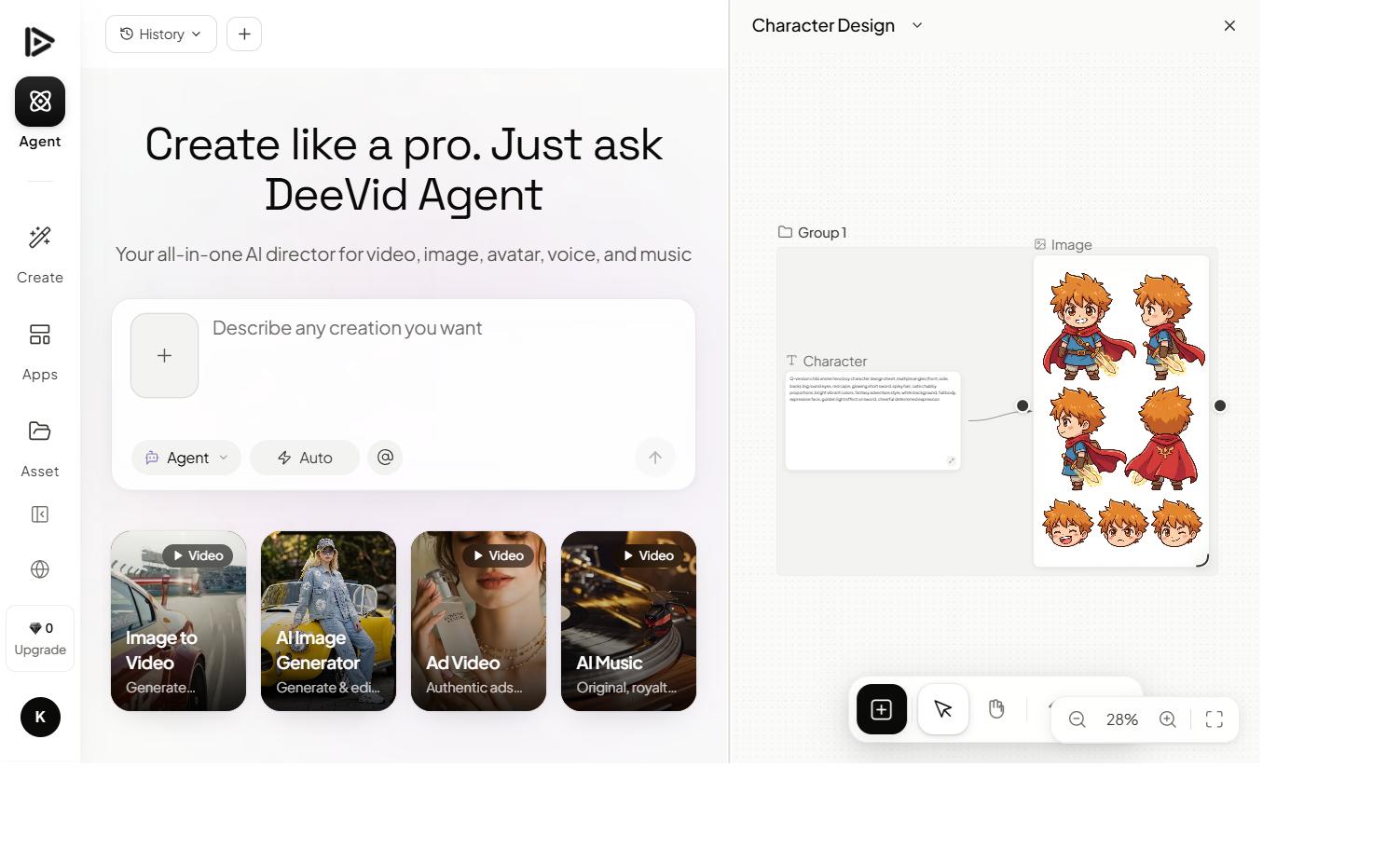
- Talk to the AI Video Agent. It asks about the brand, the message and the visuals, then proposes the ad.
- Receive a complete video. Script, avatar, voice, scenes, subtitles and B-roll, in 9:16, 16:9 or 1:1.
Around that core, the site lists a long set of features. We list them as the site presents them:
- AI Video Agent, marked as new, the chat-driven way to build an ad.
- URL to Video, for turning a product page into a first draft.
- Ad Clone, which recreates the style of a winning ad with your own product.
- AI Asset Generator, for images and B-roll from a product photo or a prompt.
- 300+ AI avatars, avatars that hold or wear the product, gestures and emotions written into the script.
- AI Twin, a digital clone of yourself, and voice cloning.
- 75+ languages, French included, with auto-generated, customizable subtitles.
- 200+ video ad templates and a built-in editor.
Behind the scenes, the site names the models it routes to: Seedance 2.0 and 2.5, Kling 3.0 and 4.0, Veo 3, Wan 2.7 and 3.0, Hailuo 2.3, Vidu Q3 Pro and Grok Imagine Video for video, plus Seedream, GPT Image, Nano Banana, Flux and Ideogram for images. That list matters for pricing, because the model you pick sets the cost of every second.
How this analysis was built
It rests on the publisher’s own pages and on arithmetic we did ourselves:
- we read the pricing page, the homepage, the terms of use (effective April 15, 2025) and two help articles on credits and the free plan (both dated September 24, 2026) on October 31, 2026;
- we took screenshots of each page that carries a number you will see below;
- we did the arithmetic on the credit table ourselves and say so each time;
- we compared with the other tools on their own public pages, read the same day.
Where a page says something, we write “according to Tagshop” or “the pricing page shows”. Claims about avatar realism, speed or results are the publisher’s, and we do not rate them.
How much does Tagshop AI cost?
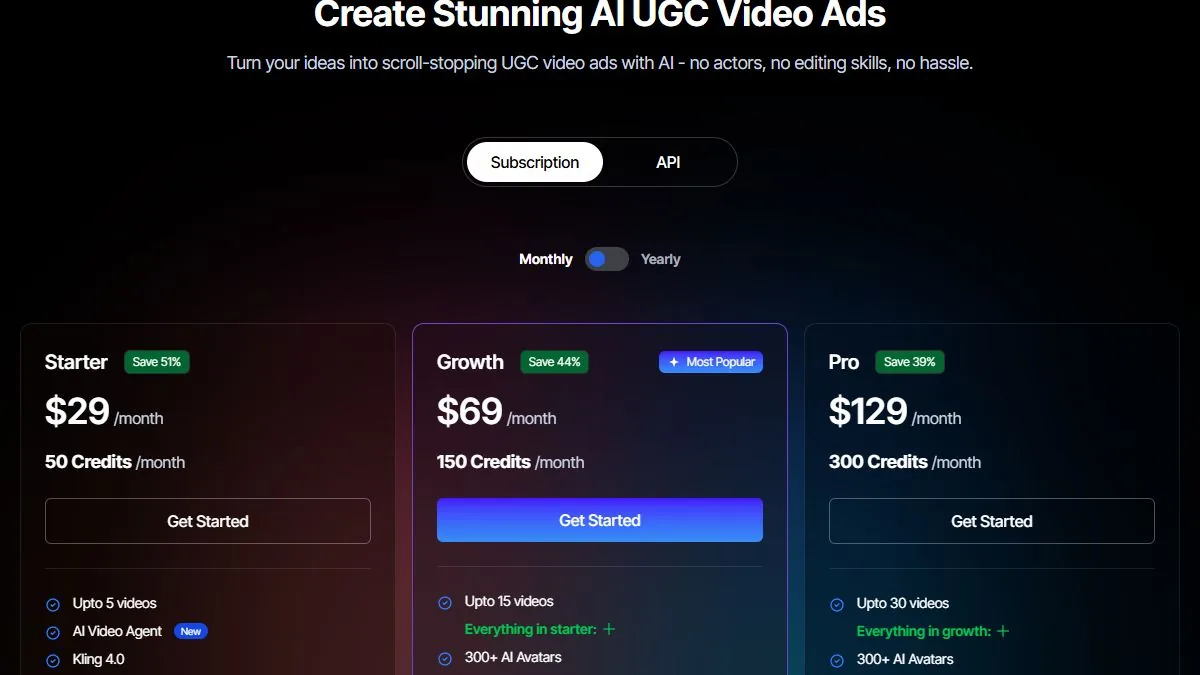
Tagshop sells subscription plans with a Monthly and a Yearly toggle. Prices are in US dollars; the page shows no euro price. These are the figures on the pricing page on October 31, 2026.
| Plan | Monthly billing | Yearly billing (per month) | Credits | “Videos” announced |
|---|---|---|---|---|
| Starter | $29 | $14 | 50 a month, or 600 a year | Up to 5 a month, up to 60 a year |
| Growth | $69 | $39 | 150 a month, or 1,800 a year | Up to 15 a month, up to 180 a year |
| Pro | $129 | $79 | 300 a month, or 3,600 a year | Up to 30 a month, up to 360 a year |
The yearly toggle is the biggest lever. Starter drops from $29 to $14 a month, which means you pay $168 up front for 600 credits instead of $348 across the year. The cards show “Save 51%”, “Save 44%” and “Save 39%”. Growth is marked “Most Popular”.
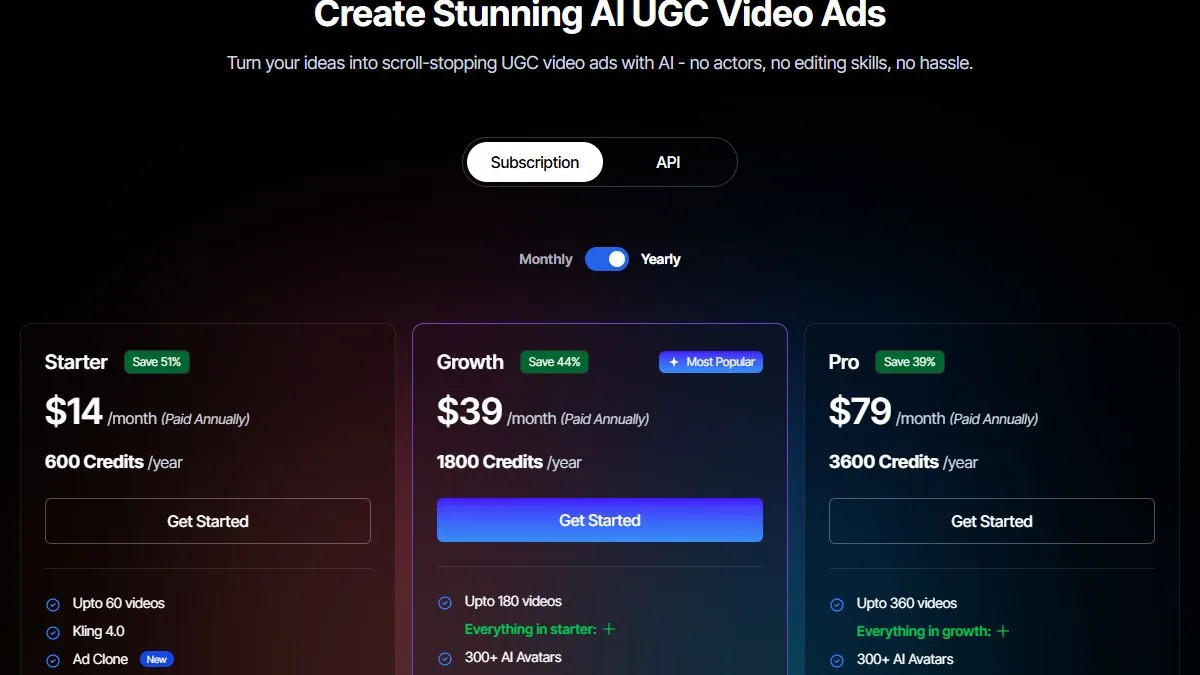
What each plan includes, according to the page:
- Starter: Kling 4.0, Ad Clone, Google Omni Flash, the AI Video Agent, 300+ avatars, 200+ templates, 75+ languages, “fast” rendering, 1080p export, no watermark, call and chat support, data kept for 3 months, AI Twin, URL to Video, the asset generator and voice cloning.
- Growth: everything in Starter, faster rendering, 4K export (listed in the comparison table), data kept for 6 months and a personalized onboarding.
- Pro: everything in Growth, the fastest rendering, data kept for 12 months and a dedicated account manager.
- Custom plan: for teams making 50 or more UGC ads, on demand.
Notice what the feature list does not change: the avatar library is the same 300+ on all three plans. You are buying credits and speed, not a bigger cast.
What does “up to 5 videos” really mean?
Here is the part the pricing card does not explain. Tagshop’s help article on credits, dated September 24, 2026, says credits are charged per second of generated video, at a rate that depends on the model and the resolution. These are the rates in credits per second:
| Model | 480p | 720p | 1080p | 4K |
|---|---|---|---|---|
| Seedance 2.0 | 0.5 | 0.9 | 2.1 | 4.3 |
| Seedance 2.5 (recommended) | 0.6 | 1.3 | 3.1 | none |
| Seedance 2.0 Fast | 0.4 | 0.6 | n/a | n/a |
| Wan 3.0 | 0.3 | 0.5 | 1.0 | n/a |
The AI Twin is billed differently: 15 credits per minute of video on every plan, plus a single credit to create the twin.
Tagshop gives its own 30-second examples: 12 credits with Seedance 2.0 Fast at 480p, 15 with Wan 3.0 at 720p, 39 with Seedance 2.5 at 720p, 63 with Seedance 2.0 at 1080p and 7.5 for a 30-second AI Twin clip.
Now do the division the pricing card leaves to you. Starter has 50 credits a month. At 39 credits per 30-second clip in the recommended model, that is about 1.3 clips. At 12 credits per clip with the cheapest model, it is about 4 clips. “Up to 5 videos” is the same 10 credits per video average, and it only holds with short or economy clips. This is our arithmetic on the publisher’s table, not a measurement.
Here is the same table turned into dollars. It divides each plan’s price by its credits (rounded to the cent here) and multiplies by the credits of a 30-second clip:
| Plan and billing | Price per credit | 30 s, Seedance 2.0 Fast 480p (12 credits) | 30 s, Seedance 2.5 720p (39 credits) |
|---|---|---|---|
| Starter, monthly | $0.58 | $6.96 | $22.62 |
| Starter, yearly | $0.28 | $3.36 | $10.92 |
| Growth, monthly | $0.46 | $5.52 | $17.94 |
| Growth, yearly | $0.26 | $3.12 | $10.14 |
| Pro, monthly | $0.43 | $5.16 | $16.77 |
| Pro, yearly | $0.26 | $3.16 | $10.27 |
Two readings come out of it. First, paying yearly roughly halves the price of every second. Second, the cheapest model produces a 30-second clip for a few dollars, while the recommended model costs three times as many credits. Whether the cheap model is good enough for an ad is a judgment about output that the credit table cannot make for you. For comparison, our AI video pricing research lines up what other AI video tools charge per clip.
Do Tagshop AI credits expire, and can you top up?
Unused credits are not carried over. On monthly plans they expire at the end of the billing cycle. On annual plans the credits stay valid through the year. When you run out you can buy a pack: 20 credits on Starter, 50 on Growth and Pro. There is no unlimited plan, and the help article says so in plain words.
Can you get a refund?
The terms of use (section 5) and the help center say all fees are final and non-refundable. In practice:
- Monthly plans: no refund once the purchase is made. You can cancel at any time from the Subscription tab, and access stays active until the end of the period.
- Annual plans: a refund is possible only in a window of 3 to 7 days after the purchase, and only if no credit has been consumed.
- Product problems: reviewed case by case.
- Unhappy with the quality: no automatic refund.
That is stricter than it looks. If you buy the yearly plan because the monthly price is double, you have a few days and zero generations to decide. The sensible order is to spend the free credits first and judge the output before paying.
Is there a Tagshop AI free plan?
Yes, a small one. The help article “Free Plan: What’s Included”, dated September 24, 2026, says the free plan gives 5 credits, once. You can use them for one AI product image (1 credit) or a 4-second test video with a watermark (4 credits) through the AI Video feature. The AI Twin is available too: one credit to create it, then a clip of up to 15 seconds. The homepage says no credit card is required, and the FAQ invites you to create a first ad and a sample before choosing a plan.
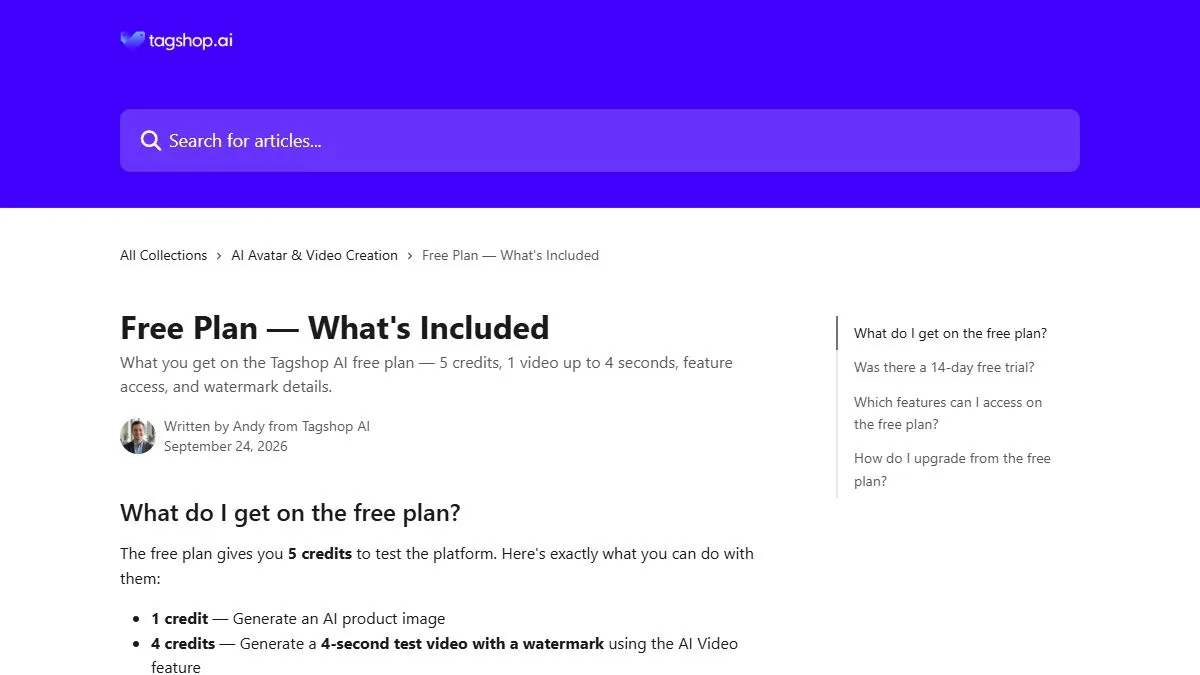
Older pages, and a few third-party comparisons, mention a 14-day free trial. Tagshop’s help center now says that trial no longer exists and that any mention of it on the site is out of date. One other help article, a competitor comparison dated September 10, still talks about “a free trial”, so the publisher’s own pages contradict each other. Believe the dedicated free-plan article, which is the newer one, and expect 5 credits.
Is Tagshop AI legit?
The honest answer has two parts. On the verifiable side, Tagshop AI behaves like a real product: public pricing in dollars, terms of use with a refund section, a help center with dated articles and a cancellation path. On the claims side, the homepage shows “4.9 on G2”, “5000+ brands worldwide” and customer-review counts, and its marketing quotes figures such as +87% ROI, +40% conversion and “about 4x CTR”. These are the company’s claims. We repeat them only so you know they exist, and we do not treat them as results.
Two clauses in the terms of use are worth reading before you upload anything. Tagshop receives a worldwide license on your inputs and outputs to provide and improve the service. And if your input contains a voice or a face, the terms say Tagshop does not commercialize it on its own without written permission. On usage rights, the publisher’s FAQ says avatars and voices are licensed for commercial use with no limit on running the ads on platforms. That is a statement by the vendor, not something we have checked in a contract.
Is AI UGC legal?
People search this because AI UGC copies the look of something that is supposed to be spontaneous. Using an avatar to present a product is not illegal by itself. The risk sits in what the avatar says and in how the ad is labeled. This is general information, not legal advice, and the rules differ by country.
- Fake testimonials. An AI “customer” who says “I used this for three weeks and my skin cleared” describes an experience nobody had. Consumer-protection rules in the United States and Europe treat made-up reviews and testimonials as deceptive. Write scripts that describe the product, not an invented personal result.
- Platform labels. Large platforms such as Meta and TikTok have introduced labels or disclosure rules for realistic AI-generated content, and the rules keep changing. Read the current ad policy of each platform before you launch.
- Likeness and voice. Make an AI Twin only of yourself, or of someone who signed a written release. Never clone a voice or a face you do not have the rights to.
- Health and finance claims. An avatar does not make a medical or financial claim lawful. The ad still needs to be true.
Tagshop’s own FAQ is candid on the other side of the question: for campaigns where human authenticity is the differentiator, human creators keep an edge, and many brands use AI for volume and humans for their hero content. That is a sensible split.
How does Tagshop AI compare with other AI UGC tools?
We have reviewed the main names, so here is a map based on public pages, with the dates of each source. No ranking: the pages give prices and features, not comparable results.
| Tool | Entry price on its page | Free option | Our coverage |
|---|---|---|---|
| Tagshop AI | $29/mo ($14 yearly), 50 credits | 5 credits once, watermark | This review |
| Creatify | $15/mo ($10 yearly), 55 credits | 10 credits a month, watermark | Creatify AI review |
| MakeUGC | $29/mo billed yearly, 500 credits | “Try any plan for $1” | Not reviewed yet |
| Arcads | Plans from $110/mo in our September check | 3-day trial advertised | Arcads AI review |
The Creatify and Arcads prices come from our own reviews, with the dates stated there; MakeUGC’s comes from its pricing page read on October 31. If you want the full by-job breakdown, our Creatify alternatives guide and the wider AI UGC tool stack cover it, our Topview AI review looks at another product-link-to-video tool, and our guide to the best AI video generator for ads explains when a generator beats an avatar tool.
Credits are not a common currency: 50 Tagshop credits and 55 Creatify credits buy different things, so do not compare them one for one. What the table does show is where the price sits. Paid monthly, Tagshop’s $29 is above Creatify’s $15 and far below the $110 listed in our September Arcads check. Paid yearly, its $14 is a little above Creatify’s $10. Whether the extra money buys different output is not something pricing pages can show.
Who should use Tagshop AI, and who should skip it?
From the pages alone, here is where Tagshop looks like a fit:
- E-commerce sellers and dropshippers who start from a product page and want a quick first draft from a URL.
- Small teams that need volume and can live with economy models, where the credit table puts a 30-second clip at about 12 credits.
- People who want an AI clone of themselves for presenting offers. The AI Twin rate of 15 credits a minute is the cheapest per-second line in the whole table.
- Marketers who run several languages, since 75+ are listed, once you have confirmed the quality in yours.
And where we would hesitate or skip:
- Anyone who needs the most natural actor for one flagship ad. The pages offer no verifiable promise on realism beyond the vendor’s own claims. Compare on your script first.
- People who cannot afford a mistake on an annual plan. The refund window is short and closes as soon as one credit is used.
- Teams that need predictable costs. Per-second billing by model makes a monthly budget harder to plan than a flat videos-per-month allowance.
- Brands whose ads rely on authentic human testimony. Hire real creators for that part.
Our verdict on Tagshop AI, for now
What the pages show: the product is clearly specified, the prices are public, the credit table is detailed enough to do your own math, and the plan structure is simple. Paying yearly is much cheaper per credit. Refunds are strict, which is reasonable to know before paying. The 5 free credits are a very small trial, enough for one image or a 4-second clip.
What to weigh: avatar realism, voice quality in your language and the real credit cost of a finished ad depend on your script and your product, and the pricing pages cannot settle them. The marketing figures are the publisher’s claims, so we give Tagshop AI no score and no ranking. The most reliable thing on the page is the credit table.
Our practical advice is the same as for any tool in this category: write one 20 to 30-second script for a real product, spend the free credits on it, note what the generation cost, and only then choose between monthly and yearly.
Try your own script before choosing a plan. The free plan is 5 credits, watermarked, and a card is not required to start. Paid plans start at $29 a month, or $14 a month billed yearly.
FAQ
Is Tagshop AI free?
Partly. According to Tagshop's help center (article dated September 24, 2026), the free plan is 5 credits, given once and not every month. That covers one product image, or a 4-second test video with a watermark. The 14-day free trial that older pages mention no longer exists. Paid plans start at $29 a month, or $14 a month billed yearly.
How much does Tagshop AI cost?
On the pricing page read on October 31, 2026: Starter is $29 a month for 50 credits ($14 a month billed yearly for 600 credits a year), Growth is $69 a month for 150 credits ($39 yearly), and Pro is $129 a month for 300 credits ($79 yearly). Prices are in US dollars. There is no unlimited plan, and extra credits are sold in packs of 20 (Starter) or 50 (Growth and Pro).
How many videos can I make with 50 credits?
Tagshop says up to 5 videos on Starter, which is 10 credits per video. Its own credit table shows why that is a best case: a 30-second clip costs 12 credits with Seedance 2.0 Fast at 480p but 39 credits with Seedance 2.5 at 720p. By that table 50 credits is about four economy clips or one standard-quality clip of 30 seconds.
Is Tagshop AI legit?
It has the signs of a real product: public pricing, terms of use, a refund policy and a dated help center. The figures on its site (4.9 on G2, 5,000+ brands, +87% ROI) are the company's own claims, not independent results. Treat it as a tool to try on the free credits before paying.
Can I get a refund on Tagshop AI?
Only in narrow cases. The terms and help center say fees are final and non-refundable. Monthly plans are not refunded once bought. Annual plans can be refunded within a window of 3 to 7 days after purchase, and only if no credit has been used. Cases of a product defect are reviewed one by one. Dissatisfaction with quality does not trigger an automatic refund.
Does Tagshop AI work in French and other languages?
Tagshop lists more than 75 languages, French included, plus voice cloning. The pages give no quality rating by language, so try your own script on the free credits before you plan a campaign around it.
Do Tagshop AI videos have a watermark?
On the free plan, yes: the test video is watermarked. The paid plans are listed without a watermark, with 1080p export on Starter and 4K export on Growth and Pro according to the plan comparison table.
Is AI UGC legal?
Using AI avatars in ads is not banned as such, but fake testimonials are the risk. A made-up customer claiming to have used your product can fall under consumer-protection rules on fake reviews, and ad platforms ask you to label realistic AI content. Use only avatars and voices you are licensed to use, and never fake a personal experience. This is general information, not legal advice.