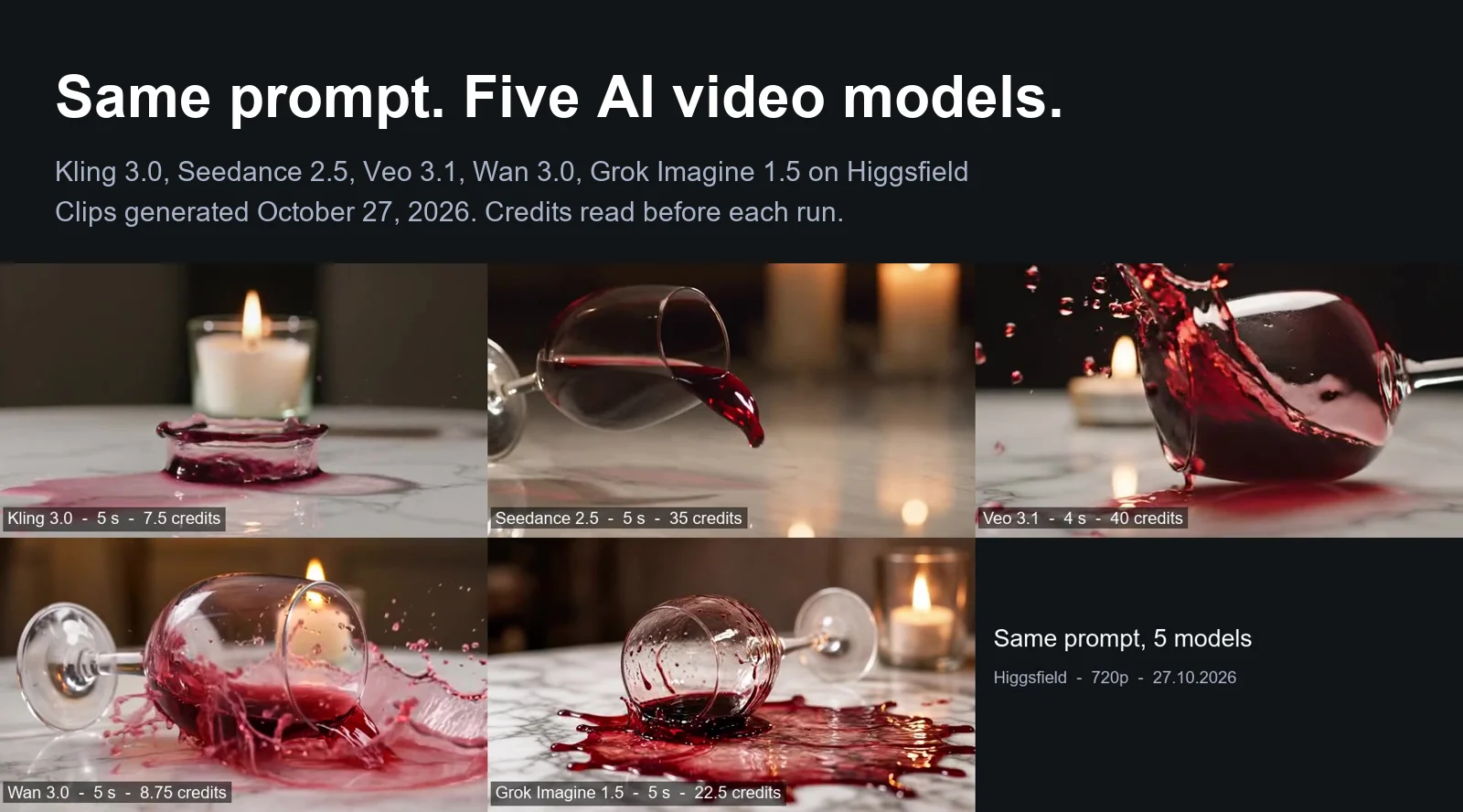
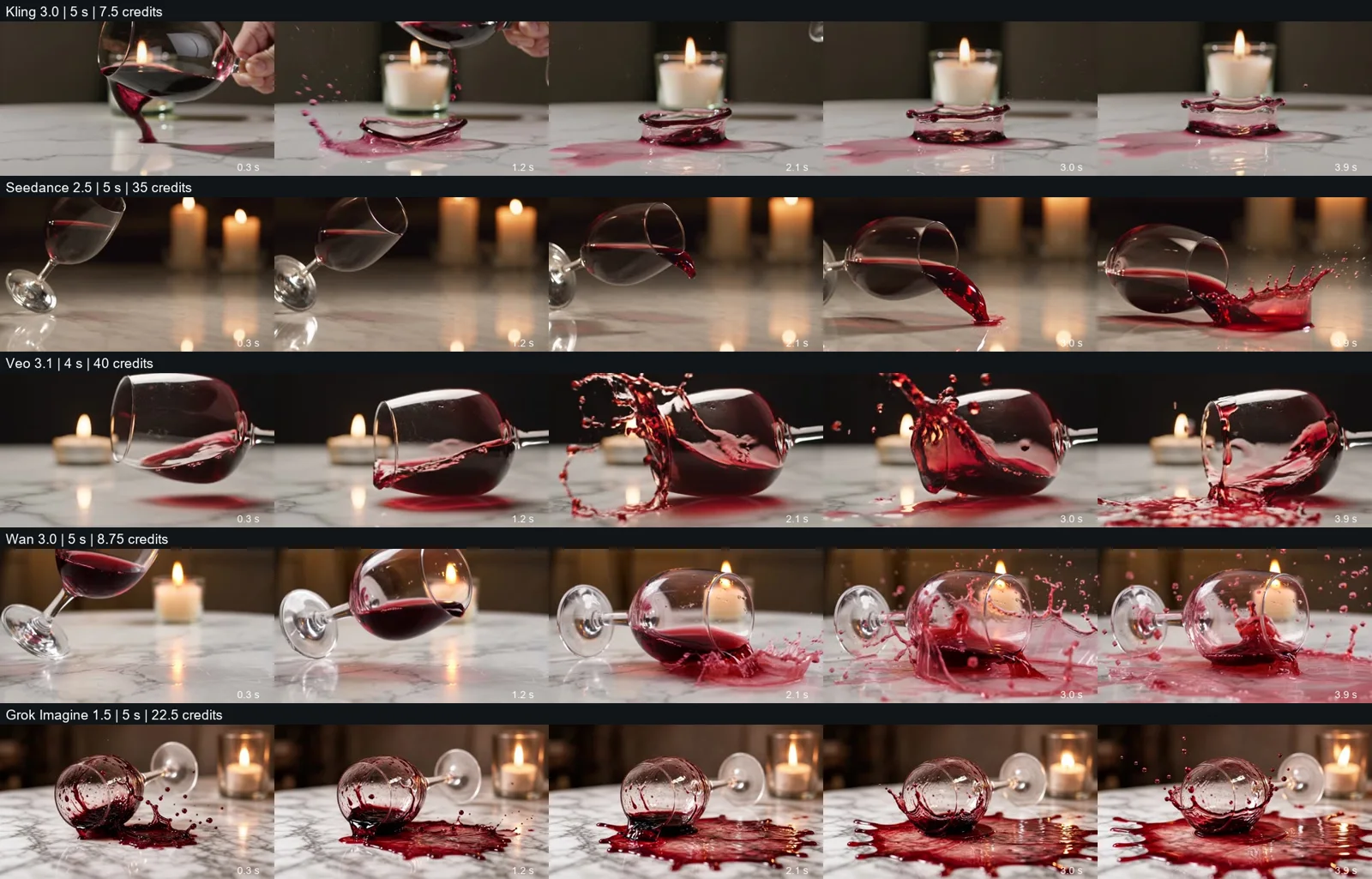
Short answer: we sent one prompt, a glass of red wine tipping over on marble in extreme slow motion, to five AI video models inside Higgsfield: Kling 3.0, Seedance 2.5, Google Veo 3.1, Wan 3.0 and Grok Imagine 1.5. The five clips cost 113.75 credits together, between 7.5 and 40 credits each. Seedance 2.5 told the whole story most faithfully, Veo 3.1 made the most dramatic splash, Wan 3.0 delivered a convincing result for 8.75 credits, Kling 3.0 was the cheapest, and Grok Imagine 1.5 started after the accident was over. One draw per model, one scene, so treat it as a tendency, not a ranking.
Clips generated on October 27, 2026 on an Ultra plan provided by Higgsfield for one month. Higgsfield did not review this page. It contains affiliate links (disclosure).
The same-prompt test at a glance
- Total cost: 113.75 credits. Kling 3.0 at 7.5, Wan 3.0 at 8.75, Grok Imagine 1.5 at 22.5, Seedance 2.5 at 35 and Veo 3.1 at 40 for only 4 seconds.
- Cost per second: Kling 1.5 credits, Wan 1.75, Grok 4.5, Seedance 7, Veo 10.
- Closest to the prompt: Seedance 2.5 (tip, pour, crown splash, soft candles) and Veo 3.1 (big airborne splash, cinematic dark background).
- Most literal, least faithful to the story: Kling 3.0 drew a hand pouring the glass and a neat crown of wine. Grok Imagine 1.5 opened on a glass already in the spill.
- One trap on the price tag: Kling 3.0 opens at 4K for 30 credits per 5 seconds, against 7.5 at 720p.
- Limits: one draw per model, five frames per clip inspected, mixed durations and sound settings. Details below.
How we ran the test
We used a deliberately awkward scene. Liquid, clear glass, reflections and a background that has to blur are exactly where a weak model gives itself away within a second. We wrote the prompt in English and sent it unchanged to every model:
A glass of red wine tips over on a white marble table in extreme slow motion, wine splashing into a crown shape, a candle flame flickering behind it, macro lens, shallow depth of field, warm cinematic lighting, photorealisticWe asked for 720p and 16:9 wherever the setting existed and generated each clip once. Before every launch we read the credit price on the Generate button, and we checked the account balance before and after each run with Higgsfield’s connector. The debit matched the button every time. Where the interface offered automatic prompt rewriting (Kling and Veo) we switched it off. Seedance, Wan and Grok did not show that setting.
| Model | Duration | Resolution | Format | Sound | Note |
|---|---|---|---|---|---|
| Kling 3.0 (Std) | 5 s | 720p | 16:9 | Off | Prompt enhancer off |
| Seedance 2.5 | 5 s | 720p | 16:9 | Off | Bitrate “High” (default) |
| Google Veo 3.1 | 4 s | 720p | 16:9 | Native audio | Options are 4, 6 or 8 s; we took the shortest |
| Wan 3.0 | 5 s | 720p | Auto | Off | Output came out 1280 x 720 |
| Grok Imagine 1.5 | 5 s | 720p | Auto | Native audio | No format switch shown; output 1280 x 720 |
What is not identical: Veo’s 4 seconds instead of 5, the “auto” format on Wan and Grok, and the audio track on Veo and Grok. We keep that in view when we compare prices.
Kling 3.0: the cheapest, and the most literal
Seven and a half credits for 5 seconds is 1.5 credits a second, the entry price of the whole series. On the frames we extracted, a hand enters at the top of the shot and pours the glass instead of letting it tip over. The wine falls, forms a very neat circular crown on the marble and the glass leaves the frame. The candle stays far sharper than in the Seedance clip, even though the prompt asked for shallow depth of field.
It is pretty and very “ad-like”, and the crown is literal. But nobody mentioned a hand, so the story drifts from the text. For testing shot ideas without burning credits, it is a sensible default. For illustrating a prompt to the letter, this draw was not enough. Our Kling guide covers the model on its own.
Seedance 2.5: the most faithful, at 35 credits
Thirty-five credits for 5 seconds, 7 a second, nearly five times the Kling price for the same duration. On our five frames, the glass tips gradually, a thin stream of wine pours out and a crown of splashes appears near the end (around 3.9 seconds), with the candles dissolving into soft bokeh. It is the only clip that respects the tip, the slow motion and the macro look at once.
One detail worth knowing: switching sound on or off did not change the price. It was 35 credits both ways. Our Seedance guide explains how to reach the model and what it costs elsewhere.
Veo 3.1: the biggest splash, for 4 seconds
Forty credits for 4 seconds is 10 credits a second, the highest rate in the test. The glass is already lying down in the first frame, the wine sloshes, and big splashes fly into the air between the second and third second. The background is dark, the contrast strong, the look cinematic, and an audio track comes with it.
The catch is duration. The selector offers 4, 6 or 8 seconds, and the button showed 80 credits for 8 seconds at 720p. There is also a Fast variant, which we tried on a vertical shot at 16 credits for 4 seconds. Our Veo pricing guide covers the official routes.
Wan 3.0: a convincing splash for 8.75 credits
The button showed 9 with a crossed-out 13, a promotion on the day, and the account was debited 8.75. That is 1.75 credits a second. The glass tips from its base, lands, and a crown-shaped splash opens on the right with lots of small separate droplets, while the candle stays visible behind the glass. It is the draw whose realism-for-price surprised us the most.
Grok Imagine 1.5: the accident is already over
Twenty-two and a half credits, 4.5 a second. From the first frame the glass already sits in a red pool that slowly spreads. We see the aftermath, not the accident. The picture is sharp, the marble reflections are convincing and the candle is there, but for this prompt it was the least faithful draw. One generation cannot judge a model, and a simpler prompt might go very differently.
Credits and dollars
Higgsfield bills in credits, so dollars depend on your plan. On the pricing page we read on October 26, 2026, Ultra was $129 for 3,000 credits (about 4.3 cents a credit), Plus $59 for 1,200 and Starter $19 for 270. Our account showed euros with a personal promotion, so treat this as an order of magnitude. The arithmetic below is ours, at those list prices.
| Model | Credits | Duration | Credits per second | About, at Ultra list price | Prompt fidelity (our reading) |
|---|---|---|---|---|---|
| Kling 3.0 | 7.5 | 5 s | 1.5 | $0.32 | Medium: neat crown, but a hand pours the glass |
| Wan 3.0 | 8.75 | 5 s | 1.75 | $0.38 | Good: tip, crown splash, fine droplets |
| Grok Imagine 1.5 | 22.5 | 5 s | 4.5 | $0.97 | Low: glass already in the spill |
| Seedance 2.5 | 35 | 5 s | 7 | $1.51 | Very good: tip, pour, crown, bokeh, slow motion |
| Veo 3.1 | 40 | 4 s | 10 | $1.72 | Very good: big splash, cinematic, very short |
All five clips together: 113.75 credits, about $4.90 at the Ultra list price, or around $8 at Starter’s rate (113.75 credits at $19 per 270). If you want to see how this compares with other tools, our AI video pricing research lists Higgsfield next to 12 others, and the Deevid vs Higgsfield page covers the bundle question.
Which model for which job
This test cannot name a universal winner, but it ranks reflexes, provided you remember it rests on a single scene:
- Drafting and testing shot ideas: Kling 3.0 at 720p (7.5 credits) or Wan 3.0 (8.75 on the day of the test).
- A shot where the story has to follow the prompt, in slow motion: Seedance 2.5, accepting 35 credits for 5 seconds.
- A short shot that has to look striking: Veo 3.1, knowing 8 seconds cost 80 credits.
- A longer shot: Kling 4.0 gave us 10 seconds at 1080p for 20 credits at the displayed price (40 crossed out), the best duration-for-price of the session. We did not analyze that clip beyond a single frame.
- Grok Imagine 1.5: try it again on a simpler prompt before forming an opinion.
Five more clips from the same session
After the protocol we ran other shots to see what Kling 3.0 gives at 1080p: 8.75 credits for 5 seconds, barely above the 7.5 it costs at 720p. Each caption gives the model, duration, resolution, price and the exact prompt.
On the frames we extracted, the whale’s light and the fisherman’s skin texture are believable. For these shots we examined one frame per clip only, so watch them in motion before judging the gestures.
This one is here on purpose: not every shot works. We asked for a luxury perfume bottle, and the frame shows a glass of golden liquid with bubbles on a black reflective plate, not an identifiable bottle. For real product shots, start from a photo of the product (Higgsfield’s image-to-video mode, which we tested in our full Higgsfield review) instead of describing the object.
Two vertical shots for Shorts and Reels
The 9:16 format is set in the format selector before generating, with no cropping: the files came out at 1080 x 1920 for Kling and 720 x 1280 for Veo Fast. At 8.75 and 16 credits a shot, it is a workable price if you feed a Shorts channel.
What this test cannot tell you
Let us be exact about what it does not prove. First, one generation per model: the same prompt run again gives another clip, and any model can have a bad draw. Second, one scene: a wine glass tests liquid and transparency, not faces, hands, text or long takes. Third, we looked at five frames per clip and read the motion from there, not frame by frame across the 120 frames of each clip. Finally, the differences in duration, format and sound make the price comparison approximate.
On comfort: Higgsfield’s web app was heavy in our Chrome. Typing a prompt froze the page for about thirty seconds several times, although the text was always registered. The “Unlimited mode” switch on Kling 3.0 opens a paid offer (from 35 euros for one day to 158 euros for seven days that day), which we did not buy.
Run the test yourself without the traps
- Read the price on the Generate button before every launch. In our test the debit always matched it.
- Check Kling 3.0’s resolution. It opens at 4K: 30 credits for 5 seconds, against 7.5 at 720p and 8.75 at 1080p.
- Switch off automatic prompt rewriting when you compare models, or the tool edits your text.
- Keep duration and format identical wherever the models allow it, and note where they do not (Veo offers 4, 6 or 8 seconds).
- Note your balance before and after each clip. It is the quickest way to catch an expensive setting.
- Do not click “Unlimited” offers until you have worked out your real usage.
Repeat our wine-glass test with your own prompt. Start with Kling 3.0 at 720p, read the number on the button, then try a second model before you commit to a plan.
For writing prompts that do better than ours, our prompt guide breaks a good shot into subject, action, camera, light and mood. The official Kling and Wan sites list the versions and access routes currently offered, which change fast.
FAQ
Which AI video model is best in 2026?
There is no single best model, and this test does not crown one. On our wine-glass scene, Seedance 2.5 followed the prompt most completely, Veo 3.1 produced the most dramatic splash in 4 seconds, Wan 3.0 gave a believable result for 8.75 credits, and Kling 3.0 was the cheapest at 7.5. Grok Imagine 1.5 showed the glass already lying in the spill. One draw per model is a tendency, not a ranking.
How much does a 5-second AI video cost on Higgsfield?
On October 27, 2026 we paid 7.5 credits for Kling 3.0 at 720p, 8.75 for Wan 3.0, 22.5 for Grok Imagine 1.5 and 35 for Seedance 2.5. Veo 3.1 cost 40 credits for 4 seconds, and the button showed 80 for 8 seconds. At the Ultra list price of $129 for 3,000 credits that is roughly 32 cents for the Kling clip and $1.50 for the Seedance one.
Why did you generate each clip only once?
To keep the budget readable: the five clips cost 113.75 credits in total, about $4.90 at the Ultra list price. The downside is that one weak draw can make a model look worse than it is. A serious benchmark would use several prompts and several draws per model.
Are the videos edited or retouched?
No. They are the files Higgsfield returned, recompressed to H.264 for the web. The only edited piece is the side-by-side grid, which we assembled from the five files.
Did all five clips have sound?
No. We turned sound off for Kling 3.0, Seedance 2.5 and Wan 3.0. Veo 3.1 and Grok Imagine 1.5 returned files with an audio track and offered no visible switch to remove it. We did not review the audio.
Is Veo 3.1 always the most expensive?
Per second, yes in this test: 10 credits a second against 7 for Seedance 2.5. The Fast variant is much cheaper: a 4-second vertical clip at 720p cost 16 credits in our run.
Can I use these clips commercially?
It depends on the tool's terms, your plan and the law where you publish. Read the terms before a client project, keep your prompts and files, and label AI-generated media where transparency matters.